
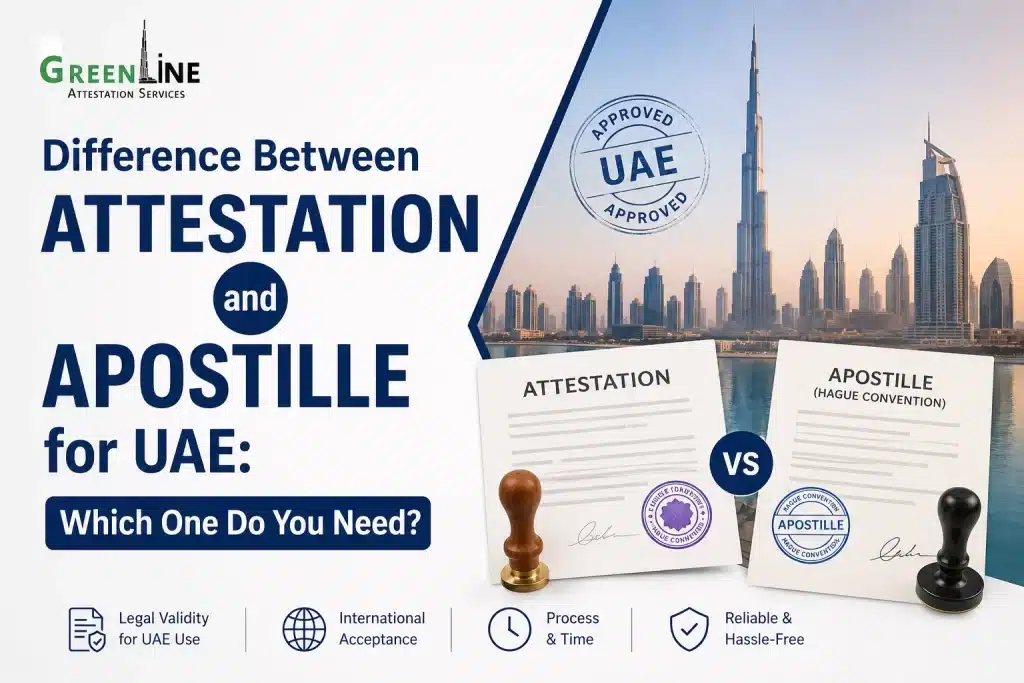

If you’re planning to work, study, start a business, or apply for a family visa in the United Arab Emirates, you’ve probably run into two terms that get confused constantly: certificate attestation in uae and apostille. Both authenticate documents for use in another country but they are not interchangeable, and using the wrong one for the UAE can get your documents rejected outright.
The most common question we hear is: Does the UAE accept apostille certificates, or is embassy attestation required?
The UAE does not accept apostille as a substitute for certificate attestation. The UAE is not a member of the Hague Apostille Convention, so foreign-issued documents must go through the full attestation chain home-country authentication, UAE Embassy attestation, and Ministry of Foreign Affairs (MOFA UAE) attestation.
In this guide:
- The real difference between apostille and attestation
- Whether the UAE accepts apostille (and why a popular claim that it recently joined the Hague Convention is false)
- Realistic timelines and costs for each process
- Which documents need UAE attestation, broken down by country of origin
- A step-by-step way to decide which process applies to you
What Is Certificate Attestation?
Certificate attestation is the official process of verifying a document through multiple government authorities, so it becomes legally valid outside its country of issuance.
For the UAE specifically, attestation involves authentication in the document’s country of origin, followed by verification from the UAE Embassy and finally the Ministry of Foreign Affairs UAE (MOFA UAE). Only after all three stages are complete is a document accepted by UAE government departments, employers, universities, immigration authorities, and courts.
Certificate attestation is commonly required for:
- Employment visas
- Family sponsorship
- Student admissions
- Professional licensing
- Business setup
- Property transactions
For the full step-by-step breakdown, see our guide on the UAE certificate attestation process.
What Is an Apostille?
An apostille is a certificate issued under the 1961 Hague Apostille Convention by a designated authority in the document’s home country. Instead of requiring embassy legalization, other Convention member countries recognize the apostille as sufficient proof that the document is authentic no additional embassy step needed.
Documents commonly apostilled include:
- Degree certificates
- Birth certificates
- Marriage certificates
- Police Clearance Certificates (PCC)
- Commercial documents
- Court documents
An apostille is valid only between countries that are both members of the Hague Convention. If either the issuing country or the destination country is outside the Convention, an apostille alone won’t be accepted.
Attestation vs Apostille: Side-by-Side Comparison
| Feature | Certificate Attestation | Apostille |
|---|---|---|
| Purpose | Legalizes documents for countries requiring embassy verification | Simplifies legalization between Hague Convention countries |
| Embassy Verification | Required | Not required |
| UAE Embassy Attestation | Mandatory | Not applicable |
| MOFA UAE Attestation | Required (final step) | Not accepted alone |
| Accepted In | UAE, Qatar, Kuwait, Saudi Arabia (for embassy-route documents), and other non-Hague countries | 129 Hague Apostille Convention member countries (as of 2026) |
| Verification Authority | Home-country authority → UAE Embassy → MOFA UAE | Single designated competent authority in the issuing country |
| Number of Stamps/Steps | 3–4 stages, multiple authorities | 1 stamp, 1 authority |
| Typical Turnaround | 1–4 weeks (see table below) | 3–10 working days |
Timeline and Cost: What to Actually Expect
| Stage | Typical Timeframe | Notes |
|---|---|---|
| Local/state-level verification (Notary, HRD, Home Department, university) | 3–10 working days | Varies significantly by state/country and document type |
| Ministry of External Affairs / home-country foreign ministry authentication | 2–7 working days | Faster in countries with centralized e-verification (e.g., India’s MEA e-apostille portal — used for the apostille route only, not UAE attestation) |
| UAE Embassy attestation (in issuing country) | 3–10 working days | Some UAE embassies offer expedited service for a higher fee |
| MOFA UAE attestation (final stage, done inside the UAE) | 1–3 working days | Often same-day via the MOFA smart app if prior stages are already verified |
| Total (full attestation chain) | 2–5 weeks, occasionally longer for commercial/legal documents | Educational documents from countries with additional degree-verification steps (e.g., HRD attestation in India) can take longer |
| Apostille (Hague route only — not valid for UAE) | 3–10 working days | Only relevant if your destination is a different, Hague-member country |
Cost Considerations
Attestation costs more than an apostille because you’re paying for multiple independent verification stages rather than one stamp:
- Local/notary or state-level fees — vary by document and issuing state
- Home-country ministry fee (e.g., MEA in India)
- UAE Embassy attestation fee — charged per document, sometimes per page for commercial documents
- MOFA UAE fee — a fixed government fee, paid inside the UAE
- Translation costs — Arabic translation is often required for non-Arabic, non-English documents before MOFA attestation
- Service/agent fees — if you use an attestation service instead of handling each stage yourself
Because pricing changes with government fee revisions, we recommend getting a document-specific quote rather than relying on a fixed number, request a quote from our attestation team.
Does the UAE Accept Apostille?
No.
This is one of the most persistent misconceptions among people relocating to Dubai, Abu Dhabi, or other emirates and unfortunately, some articles online actively spread it.
Myth-Busting: “Didn’t the UAE Join the Hague Apostille Convention in 2023?”
No, it didn’t. This claim circulates online, but it’s incorrect. As of 2026, the UAE is still not a Contracting Party to the Hague Apostille Convention and is not a member of the Hague Conference on Private International Law (HCCH), the body that administers the Convention. The countries that did join around that period are different nations entirely for example, China acceded in November 2023 and Saudi Arabia joined back in December 2022. The UAE was not part of that wave, and there have been no official announcements of the UAE moving toward accession.
Why does this myth persist? Likely because:
- The UAE built its own MOFA e-legalization system with QR-code verification in 2021, which functions similarly to an apostille in spirit but it is not a Hague apostille and isn’t recognized as one internationally.
- Regionally, only Bahrain and Oman (among GCC states) have joined the Hague Convention. Saudi Arabia, Kuwait, Qatar, and the UAE remain outside it this is the regional norm, not an anomaly.
- The embassy-attestation chain gives UAE authorities more direct oversight over incoming documents, which is likely part of why there’s no urgency to join.
Bottom line: if you submit only an apostille even a perfectly valid one from a Hague member country — for a UAE employment visa, family visa, university admission, or company registration, it will typically be rejected because it hasn’t completed the UAE’s actual legalization chain.
A Note on Free Zones and Private Arrangements
Some UAE free zone authorities or private counterparties may, at their own discretion, accept an apostilled document for internal/administrative purposes — this is not official MOFA policy and isn’t something to rely on. If a free zone or business partner tells you an apostille is “enough,” get that confirmed in writing before you skip full attestation, since government departments (GDRFA, MOHRE, courts, universities) will still require complete attestation.
Why Does the UAE Require Attestation Instead of Apostille?
Rather than relying on the Hague apostille system, the UAE runs foreign documents through its own multi-authority verification chain. This approach is designed to:
- Verify document authenticity independently at each stage
- Prevent fraud in high-stakes areas like employment and immigration
- Maintain government-level oversight over foreign credentials entering the country
- Support the UAE’s own digital MOFA verification infrastructure
To understand why the final MOFA step specifically matters, see our guide on MOFA attestation in the UAE is and why it’s required .
UAE Certificate Attestation Process (Step-by-Step)
The exact chain varies by document type and issuing country, but the standard workflow is:
Step 1 — Local Verification Authentication by the relevant state authority, university, HRD, Home Department (SDM), or Notary Public in the country of issue.
Step 2 — Home-Country Foreign Ministry (e.g., Ministry of External Affairs) The ministry verifies the authenticity of the previous local approvals.
Step 3 — UAE Embassy Attestation The document is legalized by the UAE Embassy or Consulate in the issuing country.
Step 4 — MOFA Attestation in the UAE After the document arrives in the UAE, it receives final legalization from the Ministry of Foreign Affairs UAE.
If you need full support for certificate attestation for Dubai you can contact team green line attestation.
Which Documents Require UAE Certificate Attestation?
Educational Documents
Required for employment, professional licensing, and higher education:
- Degree Certificate
- Diploma Certificate
- Master’s Certificate
- Academic Transcripts
If you’re applying for a work visa, see our page on degree certificate attestation for UAE employment.
Personal Documents
Required for immigration, family sponsorship, school admissions, and residency:
- Birth Certificate attestation
- Marriage Certificate attestation
- Police Clearance Certificate (PCC)
Commercial Documents
For businesses expanding into the UAE:
- Memorandum of Association (MOA)
- Articles of Association
- Power of Attorney (POA)
- Commercial Invoices
- Board Resolutions
Country-Specific Attestation Breakdown
Attestation routes differ depending on where your document was originally issued. Here’s what changes by country:
India
Educational and personal documents typically first need state-level HRD/Home Department attestation (or, for some documents, SDM attestation), before moving to the UAE Embassy in India and then MOFA UAE. Note: India also issues Hague apostilles for documents headed to other Hague countries but if your destination is the UAE, you need the embassy-attestation route, not the apostille route, even though both start at the same MEA counter. See our India-to-UAE attestation guide for the full state-wise process.
Pakistan
Documents generally require attestation from the relevant provincial authority (e.g., Home Department) and the Ministry of Foreign Affairs Pakistan, followed by UAE Embassy attestation in Islamabad or Karachi, then MOFA UAE. Pakistan is not a Hague Convention member either, so this embassy route is the only valid path regardless of destination.
Philippines
Documents need authentication by the Philippine Statistics Authority (PSA) or relevant issuing body, followed by Department of Foreign Affairs (DFA) authentication. The Philippines is a Hague Convention member, which sometimes causes confusion but since the UAE is not, Philippine nationals still need full UAE Embassy and MOFA attestation, not just a DFA apostille.
United Kingdom
UK documents typically require notarization by a UK solicitor/notary, an FCDO (Foreign, Commonwealth & Development Office) legalization stamp, UAE Embassy attestation in London, and finally MOFA UAE. The UK is a Hague member, so UK documents can be apostilled for other Hague destinations — but again, not for the UAE.
United States
US documents generally need county/state-level notarization, Secretary of State authentication, UAE Embassy attestation (Washington D.C. or the relevant consulate), and MOFA UAE. As with the UK, the US is a Hague member for other destinations, but UAE-bound documents skip the apostille entirely and go straight into the embassy-attestation chain.
The pattern across every country above: whether or not your home country is a Hague member is irrelevant once the UAE is your destination — the UAE side of the equation is what determines the process, not the origin side.
Apostille Countries vs the UAE
Countries that are members of the Hague Apostille Convention generally accept apostilles without embassy legalization. As of 2026, examples include:
- France, Germany, Italy, Portugal (EU)
- Australia, Japan, South Korea, Singapore
- United States, Canada, United Kingdom
- China (joined November 2023), Saudi Arabia (joined December 2022)
The UAE follows a separate legalization system entirely, so documents intended for use there always require the full attestation process regardless of how the issuing country treats apostilles elsewhere.
How to Choose the Right Document Legalization Process
Use this quick decision path:
- Where will you actually use the document? — If it’s the UAE, you need attestation, not apostille. If it’s a different Hague-member country, apostille is likely sufficient.
- Is your issuing country a Hague member? — This only matters if your destination is also a Hague member. For UAE-bound documents, it’s irrelevant.
- What type of document is it? — Educational, personal, and commercial documents sometimes have different attestation sub-steps (e.g., HRD for degrees in India). Confirm the exact chain for your specific document.
- Do you need Arabic translation? — Most documents need certified Arabic translation before the final MOFA UAE stage.
- What’s your timeline? — If you’re on a visa deadline, start the attestation chain as early as possible; the full process can take 2–5 weeks and delays at any single stage push back the whole chain.
Getting this decision wrong at step 1 is the single biggest cause of delays and duplicate processing always confirm based on destination, not habit or what worked for a different country.
Why Many Applicants Get Confused
Common misconceptions we still see regularly:
- “An apostille is accepted worldwide” — it isn’t; it’s only valid between Hague member countries.
- “Embassy attestation is optional if I have an apostille” — not for the UAE.
- “MOFA attestation alone is enough” — MOFA is the final stage, not a replacement for the earlier ones.
- “The UAE recently joined the Hague Convention” — it hasn’t (see the myth-busting section above).
FAQs
1. What is the difference between apostille and attestation? An apostille is a single-stamp certificate accepted between Hague Convention member countries. Attestation is a multi-stage process — home-country authentication, embassy legalization, and (for the UAE) MOFA UAE verification — required for countries outside the Convention.
2. Does the UAE accept apostille certificates? No. The UAE requires the full attestation chain: home-country authentication, UAE Embassy attestation, and MOFA UAE attestation.
3. Did the UAE join the Hague Apostille Convention in 2023? No. This is a common but false claim. The UAE remains outside the Hague Apostille Convention as of 2026, with no official accession announced. Countries that joined around that period — China (2023), Saudi Arabia (2022) — are separate from the UAE.
4. Why does the UAE require attestation instead of apostille? The UAE isn’t part of the Hague Convention and runs its own multi-authority verification framework through embassy legalization and MOFA UAE, designed to maintain closer oversight over foreign documents.
5. Which documents require certificate attestation for the UAE? Educational documents (degree, diploma, transcripts), personal documents (birth certificate, marriage certificate, police clearance), and commercial documents (MOA, Power of Attorney, invoices, board resolutions).
6. How long does UAE certificate attestation take? Typically 2–5 weeks for the full chain, depending on document type and issuing country. The final MOFA UAE stage alone is usually 1–3 working days if earlier stages are already complete.
7. Does it matter if my home country is a Hague Convention member? Not for UAE-bound documents. The UAE’s non-membership is what determines the process — your home country’s Hague status only matters if you’re sending documents to a different, Hague-member destination.
8. Can I use an apostille for UAE free zone company registration? Generally no — most free zone authorities still require full attestation for official registration documents. Some private counterparties may informally accept an apostille, but this isn’t standard policy and should be confirmed directly before relying on it.
Why Choose Green Line Attestation?
With over 10 years of experience and 1 million+ documents processed, Green Line Attestation has helped individuals, professionals, families, and businesses complete UAE document legalization with confidence — including degree certificate attestation, birth certificate attestation, marriage certificate attestation, commercial document attestation, and MOFA attestation. Our team tracks UAE requirements as they change, so you’re not relying on outdated or incorrect information (like the apostille misconception above).
Conclusion
Understanding the difference between attestation and apostille for the UAE is essential before using any foreign-issued document there. The two processes serve different legal systems, and since the UAE is not — and has not recently become — part of the Hague Apostille Convention, an apostille alone will not be accepted for official use in the country.
For employment, family sponsorship, education, or business setup, your documents need the complete UAE certificate attestation process: home-country authentication, UAE Embassy attestation, and MOFA UAE attestation. Choosing the right path from the start — and not relying on misinformation about the UAE’s Hague status — is what prevents rejections, delays, and unnecessary costs.
If you’re unsure which process applies to your documents, talk to our attestation experts and we’ll map out the exact steps for your specific document and country of origin.