
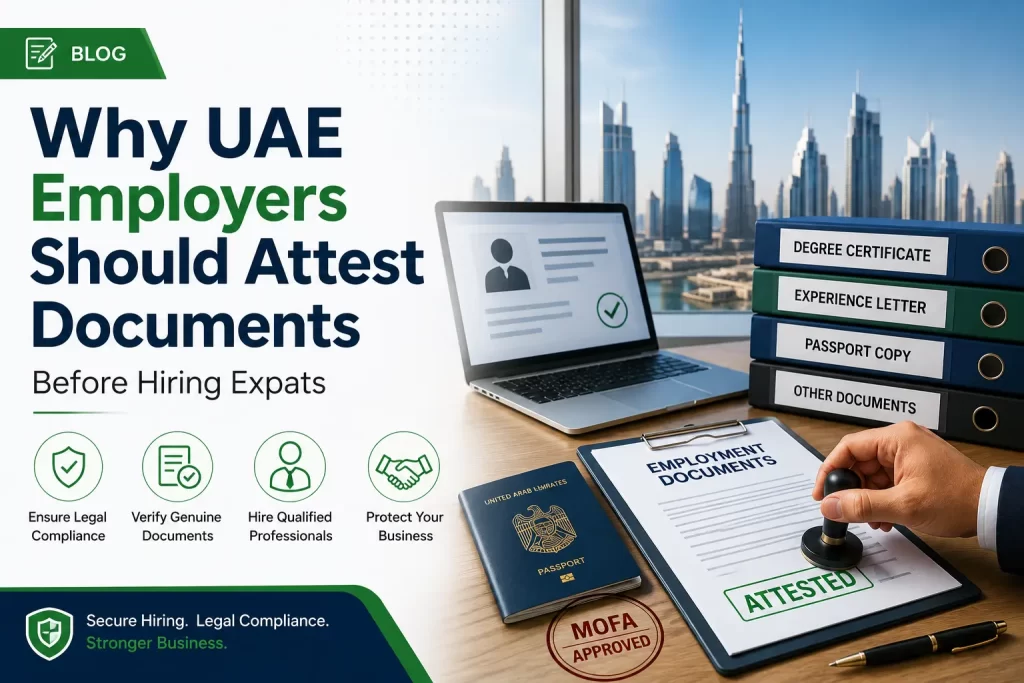

Certificate attestation is the legal authentication of an employee’s educational, professional, and personal documents by government authorities so they are recognized in the UAE. Employers require it to confirm candidate qualifications are genuine, to complete employment visa processing with MOHRE and GDRFA, and to stay compliant with UAE labor law especially in regulated sectors like healthcare, engineering, and education.
Introduction
Hiring skilled expatriate employees is essential for businesses across the UAE, but verifying their qualifications is just as important as finding the right talent. Before issuing an employment contract or starting the UAE work visa process, employers must confirm that a candidate’s educational, professional, and personal documents are legally recognized in the country.
This is where certificate attestation comes in. Attested documents let employers verify qualifications, support visa approvals, reduce recruitment risk, and meet UAE government requirements before a single dirham is spent on onboarding someone who may not be who their CV says they are.
In this guide, you’ll learn why UAE employers should attest documents before hiring expats, exactly how the attestation chain works, which certificates need verification, what it costs employers when this step is skipped, and a free readiness checklist you can use with your HR team today.
Why Do UAE Employers Require Attested Certificates?
Certificate attestation is not paperwork for paperwork’s sake it’s how an employer confirms that a candidate’s qualifications and supporting documents are authentic and legally acceptable in the UAE.
Authorities including the Ministry of Human Resources and Emiratisation (MOHRE), the General Directorate of Residency and Foreigners Affairs (GDRFA), and the Ministry of Foreign Affairs UAE (MOFA UAE) require authenticated documents at multiple stages of employment and immigration.
Attested certificates help employers:
- Verify educational qualifications
- Confirm professional credentials
- Support employment visa applications
- Meet UAE compliance requirements
- Reduce recruitment risk and hiring fraud
- Build a defensible, audit-ready HR record
Understanding the full certificate attestation process for UAE employment visas helps HR teams prepare documents correctly before recruitment even begins.
A Real-World Example of What Happens Without It
A mid-sized engineering firm in Dubai once hired a “civil engineer” on the strength of a strong interview and a degree certificate that looked legitimate. No attestation check was run before the offer was signed. Roughly two months into a live project, structural calculation errors started raising red flags. A background verification triggered at that point revealed the candidate had never actually completed the engineering degree they’d submitted.
By then, the company had already absorbed the cost of onboarding, a stalled project timeline, and the reputational exposure of having an unqualified person sign off on technical work. A single attestation and verification check at the hiring stage typically a matter of days and a modest fee would have caught this before the offer letter was even issued.
This is the pattern behind most attestation failures: the cost of skipping it is never visible upfront. It shows up later, and it’s almost always larger than the cost of doing it right the first time.
How the Attestation Chain Actually Works
Most employers know that attestation is required, but not how a document moves through the system. Here’s the typical chain for a candidate’s educational or professional certificate coming from outside the UAE:
- Notarization in the home country — a local notary or legal office verifies the document’s signature and stamp.
- State/Home Country Authority (e.g., HRD for education documents from India) — the relevant state or federal department confirms the issuing institution is recognized.
- Home Country Ministry of Foreign Affairs (or equivalent, e.g., MEA in India) — national-level authentication.
- UAE Embassy/Consulate in the home country — the UAE’s own diplomatic mission confirms the document for use in the UAE.
- MOFA UAE (Ministry of Foreign Affairs, UAE) — the final stamp that makes the document legally valid for use inside the UAE, often completed after the candidate arrives or via the MOFA attestation service.
Typical timeline: 5–10 working days for standard processing per document, depending on the issuing country; expedited services can bring this down to 1–3 days. Typical cost: ranges by document type and urgency, with personal/educational documents generally costing less than commercial documents. Employers should build this lead time into their offer-to-joining timeline, particularly for candidates from countries with slower home-country verification steps.
Attestation vs. Equivalency Certificate — Know the Difference
This is one of the most common points of confusion for HR teams, especially when hiring for regulated roles, and it’s worth being precise about:
| Attestation | Equivalency Certificate | |
|---|---|---|
| What it confirms | The document (and the stamps/signatures on it) is genuine | The qualification is equivalent to a recognized UAE/GCC standard |
| Issued by | Notary → home country ministry → UAE Embassy → MOFA UAE | UAE Ministry of Education (for academic degrees) or relevant licensing authority |
| When it’s needed | Almost always, for any foreign document used officially in the UAE | Specific regulated roles — e.g., government jobs, some healthcare/teaching licenses, certain engineering registrations |
| Sequence | Usually the first requirement | Usually required after attestation is complete |
In short: attestation proves the document is real. Equivalency proves the qualification meets a specific UAE standard. Employers hiring for licensed professions (see the industries below) should check whether their candidate needs both not just attestation alone.
What Documents Should Employers Verify Before Hiring Expats?
The exact documents required depend on the role and the purpose of employment.
Educational Documents
- Degree Certificate
- Diploma Certificate
- Master’s Certificate
- Academic Transcripts
- Professional Certifications
For professionals relocating from India specifically, completing Indian certificate attestation for employment is a common first step, since India-issued documents follow a distinct HRD/MEA chain before reaching the UAE Embassy.
Professional Documents
- Experience Certificate
- Professional License
- Registration Certificates
- Skill Certifications
Some regulated professions require additional verification directly from licensing authorities before employment can begin.
Personal Documents
Depending on visa and sponsorship needs, employers may also request:
These are most often required for family/dependent visa sponsorship once employment is confirmed.
Industries That Require Strict Document Verification
Every employer benefits from document verification, but some sectors carry stricter regulatory consequences for skipping it.
Healthcare — Doctors, nurses, pharmacists, and allied health professionals typically need attested (and sometimes equivalency-certified) qualifications before licensing bodies such as DHA, DOH, or MOH will issue a professional license. Read more on certificate attestation requirements for healthcare jobs in the UAE.
Engineering & Construction — Firms routinely verify technical qualifications and professional certifications before recruitment, particularly for roles involving structural sign-off or safety accountability.
Education — Schools and universities require authenticated educational certificates before appointing teaching or academic staff, and often an equivalency certificate for degree-holding faculty.
Government & Public Sector — Government entities typically apply the strictest document verification procedures of any sector for foreign hires.
What It Actually Costs Employers to Skip This Step
The risks of hiring without attested documents aren’t abstract — each one carries a real cost:
| Risk | Real-World Cost to the Employer |
|---|---|
| Visa application rejected or delayed | Reprocessing time, delayed start date, lost productivity |
| Fake or inflated qualifications discovered post-hire | Recruitment cost + training cost + cost of re-hiring, sunk twice |
| Licensing issues in regulated roles | Regulatory penalties, inability to legally deploy the employee |
| Compliance failure discovered during audit | Fines, reputational damage, scrutiny on all other hires |
| Employee turnover from mismatched skills | Full cost of a second hiring cycle within months |
A proactive attestation and verification process isn’t an added cost — it’s what prevents you from paying for the same hire twice.
What If You’ve Already Hired Someone Without Attested Documents?
This scenario is more common than most HR teams admit: an employee joins, starts working, and it’s only later — during a license renewal, an audit, or a family visa application — that unattested documents surface.
If this happens on your team:
- Don’t wait for it to be flagged externally. Start the attestation process for the outstanding document immediately; delays compound the risk the longer it sits unresolved.
- Check whether the employee has been performing duties requiring a license (healthcare, engineering sign-off, teaching) — this may need to be paused until documents are verified.
- Document the remediation step internally, so that if it comes up in a MOHRE or sector-regulator audit, you can show the gap was identified and corrected, not ignored.
- Build a standing verification checkpoint into your onboarding process going forward (see the checklist below) so this doesn’t recur across your workforce.
Employers who treat this as a one-off exception rather than a process gap tend to see it happen again with the next hire.
Employer Document Verification Readiness Checklist
Use this as a quick internal scorecard before your next expat hire reaches offer stage. Score one point for each “yes.”
- [ ] We have a written list of which documents are required for this specific role (educational, professional, personal)
- [ ] We know whether the role requires an equivalency certificate in addition to attestation
- [ ] We’ve confirmed the candidate’s home country attestation chain (which ministries/embassy apply)
- [ ] We’ve built attestation lead time (5–10+ working days) into the offer-to-joining timeline
- [ ] We have a process for verifying experience certificates, not just educational ones
- [ ] Someone in HR is responsible for tracking attestation status per candidate, not leaving it to the candidate alone
- [ ] We have a documented fallback if a candidate’s home country processing is delayed
- [ ] We’ve checked whether this hire’s sector (healthcare, engineering, education, government) has extra licensing requirements
6–8 checked: Your process is in good shape formalize it into a written SOP so it survives staff turnover. 3–5 checked: You have real exposure. Most gaps here show up during audits or visa renewals, not at hiring fix this before your next expat hire. 0–2 checked: You’re relying on candidates to self-manage a legal compliance requirement. This is where the fake-degree and delayed-visa scenarios above tend to originate.
How Certificate Attestation Protects UAE Employers
Attestation isn’t just a benefit to the employee — it directly protects the employer by helping you:
- Verify credentials before they become a liability
- Reduce hiring fraud
- Support immigration compliance
- Maintain accurate, audit-ready HR records
- Improve onboarding efficiency
- Strengthen recruitment compliance across regulated and non-regulated roles
For businesses hiring international talent regularly, attestation isn’t a one-time task it becomes part of ongoing workforce risk management.
How Professional Attestation Services Help Employers
Managing document legalization across multiple countries, each with its own chain of authorities, is time-consuming for internal HR teams to run alone. Professional attestation providers help by:
- Reviewing document requirements per role and per country
- Coordinating government authentication at each stage
- Managing UAE Embassy attestation
- Completing MOFA attestation services where required
- Providing real-time document tracking
- Reducing processing delays through established government relationships
- Supporting urgent, time-sensitive employment cases
With over 34+ years of experience in certificate attestation and more than 1 million documents processed, Green Line Attestation Dubai supports businesses across the UAE with efficient document legalization for employment, immigration, education, and business purposes.
Related Attestation Services for Employers
Depending on the employee’s circumstances, you may also need:
- Indian Degree Certificate Attestation
- MOFA Attestation Services
- UAE Embassy Attestation
- Birth Certificate Attestation
- Marriage Certificate Attestation
Using the correct service for each document type ensures nothing gets held up at the final MOFA stage the point where most delays actually occur.
Conclusion
For UAE employers, certificate attestation is a core part of responsible hiring, not a bureaucratic afterthought. Verifying educational qualifications, professional credentials, and supporting documents reduces recruitment risk, keeps employment visa processing on schedule, and satisfies UAE government compliance requirements.
Whether you’re hiring a single professional or scaling an international workforce, ensuring employee documents are properly authenticated — before the offer letter, not after a problem surfaces saves time, avoids costly delays, and protects your business.
With extensive experience supporting employers across the UAE, Green Line Attestation provides reliable certificate attestation, UAE Embassy legalization, and MOFA attestation services to help businesses onboard expatriate employees with confidence.
Frequently Asked Questions
1. Why do UAE employers require attested certificates before hiring expats?
Attested certificates let employers verify educational qualifications, comply with UAE regulations, reduce hiring fraud, and support employment visa applications before the candidate starts work.
2. Is certificate attestation mandatory for employment in the UAE?
Yes, for most employment visa applications and regulated professions — attested educational or professional documents are required before authorities like MOHRE or GDRFA will process the visa.
3. What’s the difference between attestation and an equivalency certificate?
Attestation confirms a document is genuine. An equivalency certificate confirms the qualification itself meets a recognized UAE standard. Some regulated roles (healthcare, education, engineering, government) require both.
4. What documents should employers verify before hiring foreign employees?
Common documents include degree and diploma certificates, experience certificates, professional licenses, Police Clearance Certificates (PCC), and passports — depending on the role.
5. What happens if an employee’s certificates aren’t attested?
Unattested documents can delay visa processing, block professional licensing, trigger additional verification requests, or lead to compliance issues during an audit.
6. What should an employer do if they discover an existing employee’s documents were never attested? Start the attestation process immediately, check whether the employee’s role requires a license to keep performing duties, and document the remediation so it holds up under regulatory review.
7. How long does certificate attestation take before a UAE work visa can be processed?
Standard processing typically takes 5–10 working days per document depending on the home country’s chain of authorities; expedited services can reduce this to 1–3 days.
8. How can professional attestation services help employers?
They manage the full chain notarization, home country ministry verification, embassy attestation, and MOFA attestation while tracking documents and reducing the administrative load on internal HR teams.